
Dentures often feel looser after a meal because chewing tips them, food gets under the base, and the thin layer of saliva that holds them in place gets broken. If it settles back down after you rinse and reseat it, the fit is probably fine. If the denture is loose all day, rocks when you bite, or leaves sore spots, the fit has changed or something is damaged.
Here’s why dentures slip, the signs of a poor fit, and how to tell whether you need a reline or a repair.
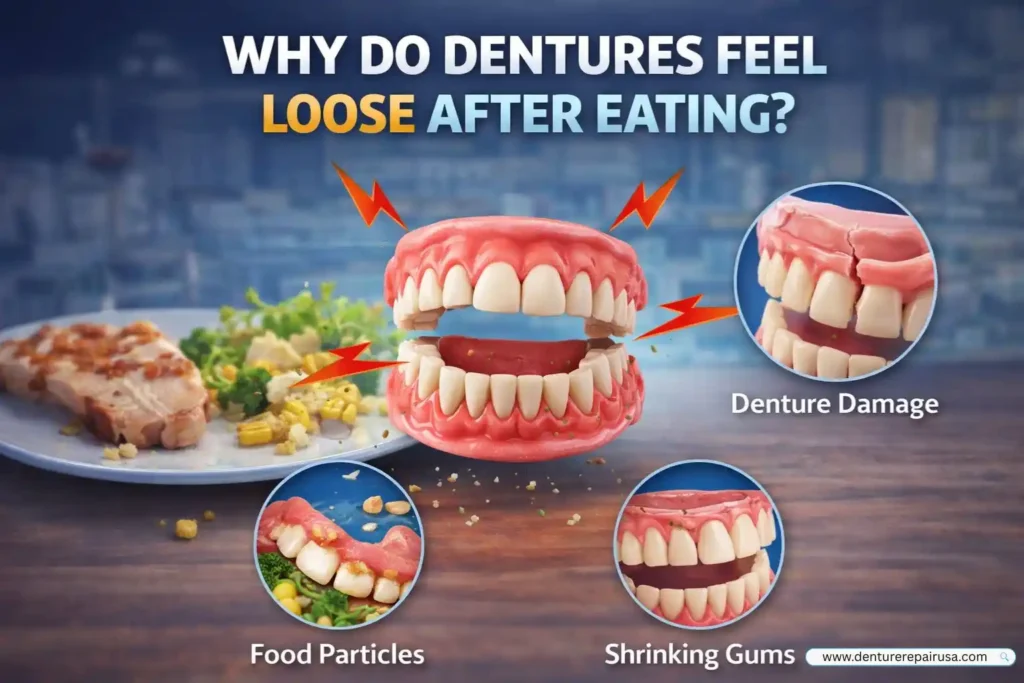
Why do dentures loosen during and after meals?
- Chewing on one side tips the denture and lifts the other side.
- Sticky or hard foods like caramel, steak or crusty bread pull on the denture.
- Food under the base breaks the suction, especially under a lower denture.
- Dry mouth. Saliva helps a denture stay put, and many common medicines cause dry mouth.
- Hot drinks and oily foods can wash away denture adhesive.
Cutting food into small pieces and chewing on both sides at once helps keep the denture level.
Signs your denture no longer fits
- It slips or clicks when you talk or laugh
- Red or sore spots on your gums
- Food gets under it at almost every meal
- You need more adhesive than you used to
- Chewing is harder than it was
- You can see or feel a gap between the base and your gums
- Your lips or cheeks look more sunken (see do dentures change the shape of your face?)
- Headaches or jaw pain (see can dentures cause headaches or ear pain?)
Why does the fit change?
The most common reason is your gums. After teeth are lost, the bone underneath slowly shrinks for years, so a denture that fit well can loosen over time. Weight loss can do the same. Worn denture teeth change your bite. A crack, or a base warped by hot water, also stops a denture from sitting where it should.
Loose fit or a broken denture?
| What you notice | Likely cause | Usual fix |
|---|---|---|
| Loose, but no damage | Your gums have changed | A reline or adjustment by your dentist |
| Suddenly loose after a drop | A hairline crack or warping | Check for a crack; crack repair from $150 |
| Rocks on one side when you bite | A crack, worn teeth or a bite change | Check for damage, then repair or adjust |
| A partial that wobbles | A bent or broken clasp | Clasp repair, free quote |
| Bite feels off after losing a tooth | Missing tooth | Reattach it ($120) or replace it (free quote) |
What to do until it’s fixed
- Look for cracks in good light, on both sides of the base. A crack can make a denture feel loose before it breaks.
- Don’t bend clasps yourself. They can snap.
- Use a little adhesive if you need it. It can help a denture feel more secure, but it can’t fix a poor fit.
- Skip home reline kits on a denture you want to keep. They’re labeled for emergency, temporary use (see do denture repair kits work?) and can change your bite.
- Stick to softer foods and cut them small.
Dentist or repair: who should you see?
See your dentist for a reline, sore spots that won’t heal, or a new denture. Bring it to us for a crack, a broken or missing tooth, or a broken clasp. Not sure which it is? Call Total Denture Repair at (314) 733-5372 and we’ll tell you. In St. Louis you can walk in Monday to Friday, 10 AM to 6 PM. From anywhere else in the U.S., use our mail-in repair.
Frequently asked questions
Is it normal for new dentures to feel loose?
Yes. For the first few weeks, your cheeks and tongue are still learning to hold the denture in place. Your dentist will usually schedule follow-up visits to adjust it.
Why is my denture loose only after eating?
Chewing breaks the seal, food slips under the base, and hot drinks can wash out adhesive. Rinse your mouth and the denture, then reseat it. If it feels secure again, the fit is probably fine.
Can a loose denture be tightened without getting a new one?
Often, yes. A reline adds a new layer to the fitting surface so it matches your gums again. Your dentist can tell you whether a reline will do it.
Can a loose denture break?
Yes. A poorly fitting upper denture flexes with every bite, and over time that can crack it down the middle. Here’s more on what causes dentures to crack or break.