
Needing more and more denture adhesive usually means your dentures no longer fit the way they used to, most often because your gums and jawbone have changed or the denture is worn, cracked, warped or has a loose tooth. A small amount used as the label directs is normal. Using too much denture adhesive, or needing more every few weeks, is a sign to have your dentist check the fit, or to get the denture repaired if it is damaged.
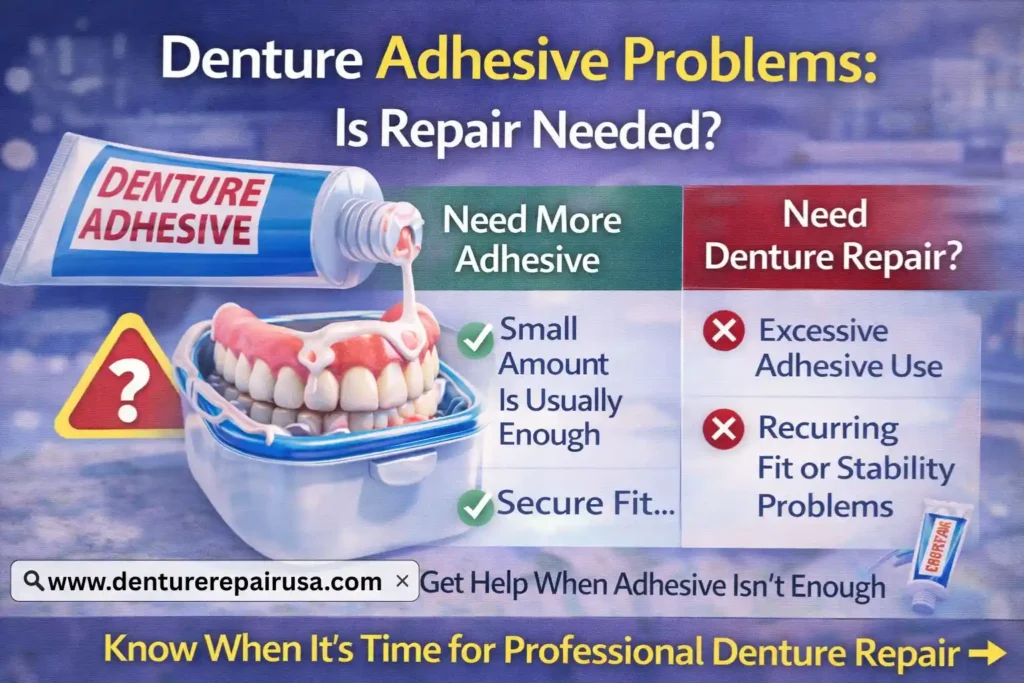
How much denture adhesive is normal, and how much is too much?
Adhesive is meant to add a little extra hold to a denture that already fits well. It is not designed to make a loose denture fit, and some people with well-fitting dentures use none at all.
The right amount is whatever your product’s label says, and it’s often less than people expect. For creams, that means a few short strips or dots, not a thick bead all the way around. For powders, it’s a thin, even sprinkle. For a well-fitting denture, one application in the morning is usually enough.
You may be using too much if:
- Adhesive oozes out around the edges when you bite down.
- You find bits of it on your tongue, in your food, or on the roof of your mouth.
- You go through tubes faster than you did a few months ago.
- You reapply after meals or by mid-afternoon.
- The denture still slips or clicks when you talk or chew, even with adhesive.
A steady increase over weeks or months tells you something has changed. For warning signs that have nothing to do with adhesive, see signs your dentures no longer fit properly.
Why do I keep needing more denture adhesive?
Needing more adhesive is a symptom, not the problem itself. These are the usual causes:
- Your gums and jawbone have changed. After teeth are removed, the bone underneath slowly shrinks over the years. Your denture stays the same shape, so small gaps open up. This is normal, and weight loss can do the same.
- The base is worn or cracked. A hairline crack lets the denture flex when you bite, which breaks the seal against your gums. Hold the denture up to a bright light and look closely.
- A tooth is loose, chipped or missing. When teeth don’t meet evenly, biting pushes one side down and lifts the other, so the denture rocks.
- The denture has warped. Hot water, a dishwasher, or letting it dry out can change its shape slightly, so it no longer sits flat.
- Old adhesive is building up. Leftover layers stop the denture from seating all the way down. Adding fresh adhesive on top makes it worse.
If yours mostly loosen during or after meals, read why dentures feel loose after eating.
Do I need a denture repair, a reline, or new dentures?
What you see and feel usually points to the right fix. Use this as a starting guide, not a diagnosis.
| What you notice | What it often means | Who to see |
|---|---|---|
| A visible crack, split or broken piece | Damage to the denture base | A denture repair service |
| A tooth is loose, chipped or has come out | Tooth damage | A denture repair service |
| Loose all over, no visible damage, food gets underneath | Gum and bone changes | Your dentist (reline or adjustment) |
| Sore spots or rubbing in one area | A pressure point or poor fit | Your dentist |
| Looks bent, or rocks after contact with hot water | Warping | Your dentist |
| Old, very worn dentures with several past repairs | Near the end of their useful life | Your dentist (may suggest new dentures) |
Relines and fit adjustments are done by a dentist. A reline adds new material inside the denture so it matches the current shape of your gums. At Total Denture Repair, we repair cracked and broken dentures and fix or replace denture teeth. We don’t do relines, fittings or oral exams.
Sometimes you need both. A loose denture flexes each time you bite, and over time that can lead to a crack. A repair fixes the break, but it does not change how the denture fits your gums. If it was loose before it cracked, have your dentist check the fit afterward. Our guide on how to tell if your dentures need relining instead of repair explains more.
How do you apply and remove denture adhesive properly?
Putting it on
- Start clean. Brush the denture and remove every trace of old adhesive.
- Follow the label on moisture. Many creams go on a dry denture, while powders usually go on a damp one.
- Use a small amount. Place a few short strips or dots a little way in from the edges, so nothing squeezes out.
- Seat it firmly. Press the denture into place, hold for a few seconds, then bite down gently.
Taking it off your gums and denture
- Loosen the seal. Swish warm (not hot) water around your mouth, then gently rock the denture loose rather than pulling hard.
- Clean your gums. Wipe them with a warm, damp washcloth or gauze, or brush gently with a soft toothbrush. Check for red or sore spots.
- Clean the denture over a towel or a sink with some water in it, so it won’t break if dropped. Brush off all adhesive with a soft denture brush and denture cleaner or mild soap, not regular toothpaste, which can scratch it.
- Keep it moist. Store it in water or a soaking solution when it’s out of your mouth. Never use hot or boiling water, which can warp it.
Is using too much denture adhesive harmful?
Used as the label directs, adhesive is a normal part of many people’s routine. Problems come from using too much for too long. Thick layers trap food and bacteria against your gums, which can cause soreness, and extra adhesive can hide a crack or fit change until it gets worse.
A note on zinc. Some older denture cream formulas contained zinc, and there were health concerns about people using very large amounts over a long time, far more than the label directed. Many brands now offer zinc-free versions. Choose a zinc-free product and never go past the directions. If you’ve used large amounts for years, tell your doctor which product you use and how much.
Take your dentures out overnight to rest your gums, unless your dentist has told you otherwise. See your dentist promptly for pain, sores that don’t go away after a few days, bleeding, swelling or any sign of infection.
Do
- Read and follow the directions on your adhesive.
- Choose a zinc-free product and start with the smallest amount that holds.
- Clean all adhesive off your denture and gums every day.
- Keep up regular dental checkups, even with no natural teeth left. Many dentists suggest at least once a year.
Don’t
- Don’t keep adding adhesive to make up for a denture that’s getting looser.
- Don’t put fresh adhesive on top of old adhesive.
- Don’t use adhesive, super glue or a home kit to hold a cracked denture together.
- Don’t rely on store-bought reline kits as a long-term fix without asking your dentist.
- Don’t keep wearing a denture that causes pain or sores just because adhesive holds it in.
Quick self-check: is it time to get your dentures looked at?
Note any of these that apply to you:
- I use more adhesive than I did a few months ago.
- I can see a crack, a chip or a thin line in the pink base.
- A tooth is loose, chipped or missing.
- Food gets trapped under my denture more than it used to.
- My gums are sore, red or bleeding.
- My denture looks bent, or feels different since it touched hot water.
What your answers mean: A crack or tooth problem needs a repair. Looseness, trapped food or sore gums with no visible damage call for a fit check with your dentist. Pain, bleeding or swelling means seeing your dentist first. If none apply, your routine is probably working fine.
What to do next
If the problem is fit rather than damage, start with your dentist. A reline or adjustment fixes the cause; more adhesive only hides it.
If you found a crack, a break or a problem tooth, get it fixed before a small crack turns into a clean break. If you’re looking for denture repair near you in St. Louis, you can walk in at Total Denture Repair, 9495 Page Ave, Monday to Friday, 10 AM to 6 PM. Most repairs are done the same day, many within a few hours. Crack repair starts at $150 for one crack, and reattaching a denture tooth you still have starts at $120. Every repair comes with a 30-day warranty.
Not close to St. Louis? With our mail-in denture repair, you order online and we send you a free USPS shipping label. We repair your denture the same day we receive it and return it free by USPS Priority Mail (USPS Express return is $30 extra). Questions first? Call (314) 733-5372.
Frequently asked questions
Is it normal to need more adhesive on a lower denture than an upper?
Yes, many people find this. An upper denture covers the roof of the mouth, giving it more surface to hold onto. A lower denture sits on a narrower ridge, and your tongue and cheeks move it more. What matters is change over time.
Can dry mouth make denture adhesive work less well?
It can. Saliva helps a denture seal against your gums, and adhesives also rely on some moisture. Dry mouth is a side effect of many medicines. Sipping water through the day can help, and your dentist or doctor can suggest other options.
Should I use adhesive with a partial denture?
Partials are usually held in place by small metal clasps that grip your natural teeth, so many people don’t need adhesive with them. If your partial feels loose, a clasp may be bent or broken, or the teeth it grips may have changed. Ask your dentist before adding adhesive. We repair broken clasps, and clasp repair quotes are free.