
To clean dentures properly, rinse them after meals, brush them once a day with a soft brush and a non-abrasive denture cleanser, soak them overnight, and rinse them before you put them back in. Avoid regular toothpaste, hot water and bleach. These three cause most of the damage we see from cleaning.
This routine follows the care guidelines from the American College of Prosthodontists (JADA, 2011). Here’s the step-by-step version, what to keep away from your dentures, and how to clean a partial.
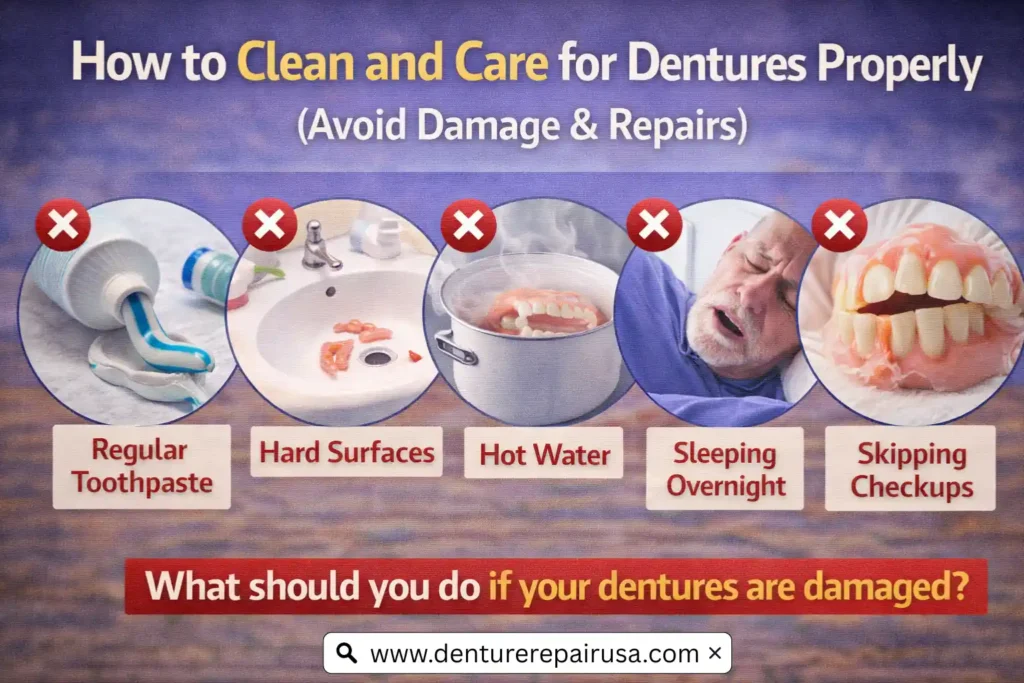
The daily cleaning routine
- Work over a towel or a sink filled with water. Most dentures that break during cleaning were dropped onto a hard sink.
- Rinse after eating to remove loose food.
- Brush once a day with a soft denture brush and a denture cleanser or mild soap. Clean every surface, including the side that touches your gums.
- Soak overnight in water or a denture soaking solution, following the product’s directions.
- Rinse well before wearing. Soaking solutions aren’t meant to go in your mouth.
- Clean your mouth too. Gently brush your gums, tongue and roof of your mouth, and any natural teeth.
What not to use on dentures
| Avoid | Why |
|---|---|
| Regular toothpaste | It’s abrasive. It scratches the acrylic, and scratches hold stains and bacteria. |
| Hot or boiling water | It can warp the base so it no longer fits. |
| Bleach | It can turn the pink base white and corrode the metal on partials. |
| Hard-bristle brushes | They scratch the surface. |
| Whitening toothpastes and strips | They’re made for natural teeth, not dentures. |
| The dishwasher | The heat can warp the denture. |
How to clean a partial denture
Partials need the same daily routine, with a few extra steps:
- Choose a cleanser that’s safe for metal if your partial has metal clasps or a metal frame.
- Brush the clasps gently. Don’t bend them while you clean. A bent clasp loosens the partial and can snap.
- Clean the natural teeth the clasps hold onto. Plaque builds up where the clasps sit.
If a clasp has already bent or broken, here’s what to do about a broken partial denture.
Stains, tartar and odor
Daily brushing and an overnight soak keep most stains away. An ultrasonic cleaner can help as an extra step, but it doesn’t replace brushing. Hard tartar that won’t come off should be cleaned by your dentist. Don’t scrape it with a knife or a pin.
A denture that smells even after cleaning usually has a buildup of bacteria in small scratches or in old, worn acrylic. A longer soak can help. If it keeps coming back, have your dentist check it.
If your denture breaks while cleaning
Keep every piece, store them dry in a clean bag, and don’t glue them. Here’s what to do if your denture broke in half. Total Denture Repair fixes a crack from $150, usually the same day. In St. Louis, walk in at 9495 Page Ave, Monday to Friday, 10 AM to 6 PM. Anywhere in the U.S., use our mail-in repair.
Frequently asked questions
Can I use toothpaste on my dentures?
It’s better not to. Most toothpastes are abrasive enough to scratch denture acrylic. Use a denture cleanser or mild soap with a soft brush.
How often should dentures be soaked?
Every day, usually overnight. Follow the directions on the cleanser for how long to soak. Rinse well before you put them back in.
Can I clean dentures with baking soda or vinegar?
Home remedies like these are often mildly abrasive or not proven for dentures. A denture cleanser made for the job is the safer choice.
Should I take my dentures out to sleep?
Yes, in most cases. It gives your gums a rest and is the best time to soak them. Here’s more on sleeping with dentures and how to store dentures safely.