
You can sleep with dentures in, but it’s usually better to take them out at night. Guidelines from the American College of Prosthodontists say dentures shouldn’t be worn around the clock, to lower the risk of denture stomatitis, an inflammation of the gums under the denture. A study of adults aged 85 and older also found that sleeping in dentures was linked to about twice the risk of pneumonia.
Here’s why a night off matters, when your dentist may tell you to keep them in, and what to do with your dentures overnight.
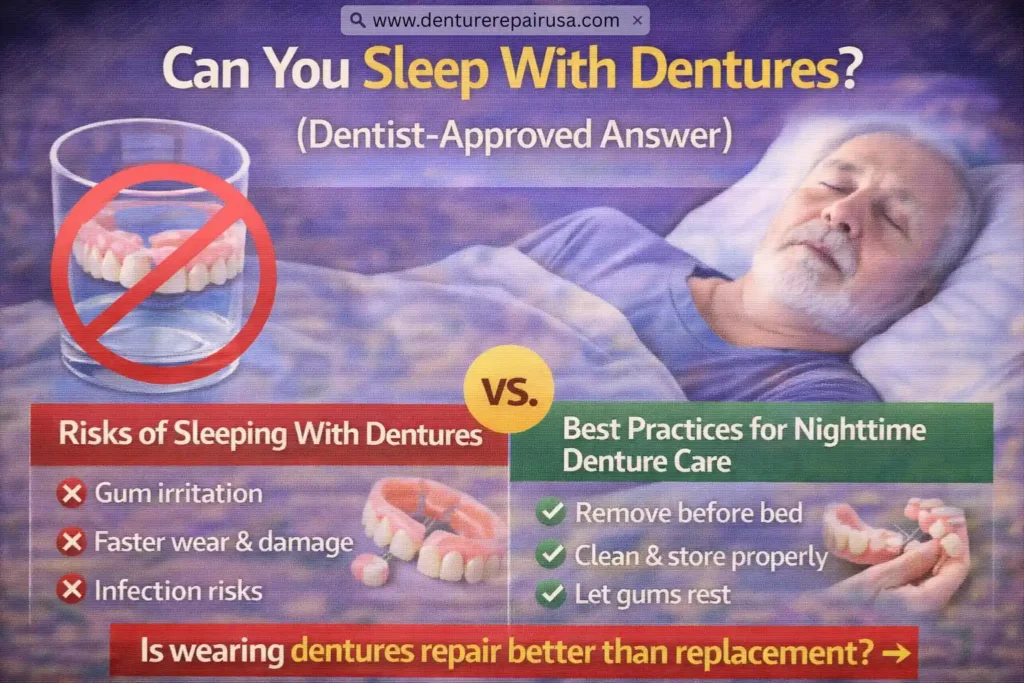
Why take your dentures out at night?
Your gums need a break. A denture presses on your gums all day. Taking it out for several hours lets the tissue recover and makes sore spots less likely.
Less denture stomatitis. This is redness and swelling under the denture, most often under an upper denture, and usually linked to yeast (Candida) that grows on the fitting surface. Wearing dentures overnight makes it more likely. The guidelines from the American College of Prosthodontists (JADA, 2011) recommend against wearing dentures continuously.
Lower pneumonia risk for older adults. In a study of 524 adults aged 85 and older in Japan, those who wore their dentures during sleep had about 2.3 times the risk of pneumonia over the study period (Journal of Dental Research, 2015). The likely reason is bacteria on the denture being breathed in during sleep.
Time to clean. Overnight is the easiest time to soak your dentures and clean your mouth properly.
Is it ever OK to sleep with dentures?
Yes, sometimes. Right after teeth are pulled and immediate dentures are fitted, many dentists tell patients to keep the dentures in for the first day and night. Follow your dentist’s instructions in that case. If your dentist has a reason for you to wear them at night, ask how to give your gums a rest at other times of the day.
Falling asleep with them in now and then isn’t a big problem. Take them out when you wake up, clean them, and give your mouth some time without them.
What to do with your dentures at night
- Brush them with a soft denture brush and a denture cleanser or mild soap. Skip toothpaste, which scratches. Here’s how to clean dentures properly.
- Soak them in water or a denture soaking solution. Dentures left out to dry can lose their shape.
- Use cool or lukewarm water, never hot. Hot water can warp the base.
- If you have a partial with metal clasps, use a cleanser that’s safe for metal. Bleach can corrode it.
- Clean your mouth. Gently brush your gums, tongue and any natural teeth.
- Rinse the denture before you put it back in.
- Keep the container somewhere safe, away from pets and the edge of the counter. See how to store dentures safely.
Can sleeping in dentures damage them?
It can. If you clench or grind your teeth at night, the denture teeth wear faster and the base takes extra stress, which can lead to a crack. Tell your dentist if you wake up with a sore jaw. A loose denture can also slip during sleep. If you notice a loose fit, here’s why dentures feel loose.
If a tooth breaks or the base cracks, don’t glue it. Total Denture Repair reattaches a tooth for $120 and repairs a crack from $150, usually the same day. In St. Louis, walk in at 9495 Page Ave. Anywhere in the U.S., use our mail-in repair.
Frequently asked questions
What happens if I fall asleep with my dentures in?
One night isn’t a problem. Take them out when you wake up, clean them, and give your gums a few hours to rest.
Should dentures be kept in water overnight?
Yes. Keep them in plain water or a denture soaking solution so they don’t dry out. Follow the directions on the cleanser for how long to soak.
Can I sleep with a partial denture?
The same advice applies: take it out at night. Also clean the natural teeth the clasps hold onto, because plaque builds up where the clasps sit.
How many hours a day should dentures be out?
There’s no exact number, but most dentists suggest taking them out overnight. If you need to wear them at night, ask your dentist about taking them out for a few hours during the day.