
Common denture damage in older adults, such as a crack, a loose or missing tooth, or a broken clasp on a partial, can usually be repaired, often the same day, without replacing the denture. Families and caregivers help most by checking the denture once a week while cleaning it, noticing quiet signs like eating less or leaving the denture out, and getting damage fixed early. Pain, sores, bleeding or a change in fit should be checked by a dentist.
This guide is for the adult children, spouses, home aides and care home staff who help an older person with their dentures.
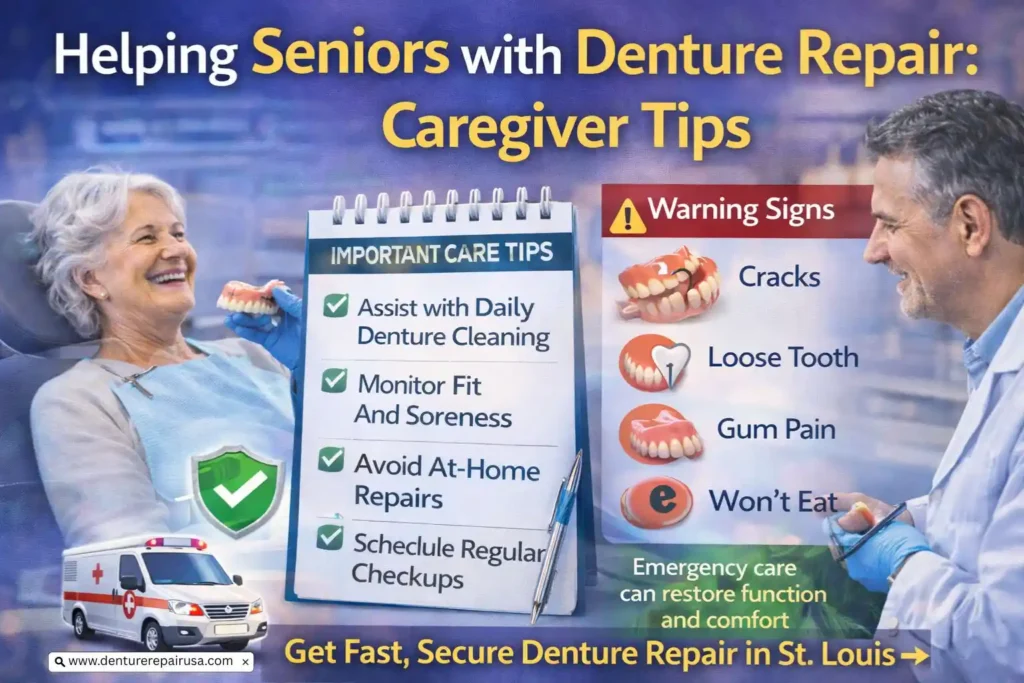
How can you check someone else’s denture for damage?
The easiest time is while you’re already cleaning it. Pick the same day each week. Work over a folded towel or a sink with a few inches of water, so a slip doesn’t become a break. Good light and reading glasses help.
Why every week? A thin crack can spread with every bite until the denture snaps. A loose tooth can fall out at a meal and get thrown away in a napkin. Catching damage early usually means a simpler repair and less time without teeth.
Weekly caregiver checklist
Print this list or copy it onto a card kept with the denture case. Note the date each week. Any “yes” deserves a closer look.
- Base: Held up to a light, is there any crack, even a faint line? Check the middle of an upper denture and around the front teeth.
- Edges: Does anything feel sharp, rough or chipped when you run a fingertip around them?
- Teeth: Does any tooth move when pressed gently? Is any chipped, worn flat or missing?
- Clasps (partials only): Are the small hooks that grip the natural teeth bent, cracked or loose?
- Gums: With the denture out, are there sore spots, red or white patches, or bleeding?
- Eating: Are they eating less, or skipping foods they usually enjoy?
- Speech: Is there new whistling, lisping or clicking when they talk?
- Wear: Have you found the denture out when they would normally wear it?
- Adhesive: Are they using more denture adhesive than before?
- Case: Is the case dirty, cracked or missing a name label?
A “yes” on the first four items usually means a repair. A “yes” on gums, speech or adhesive usually means a call to the dentist.
What signs might an older person not mention?
Many older adults don’t mention denture trouble. They may not want to be a bother, may feel embarrassed, or may have memory changes. A crack underneath can also be hard for them to see. So watch what they do, not only what they say.
| What you notice | What it can mean | What to do |
|---|---|---|
| Eating less or skipping meals | Chewing hurts, the denture rocks, or a tooth is missing | Check the denture; see the dentist if the gums are sore |
| Avoiding meat, raw vegetables or crusty bread | A loose fit, a cracked base or a loose tooth | Do the weekly check and repair any damage |
| Mouth sores, red spots or bleeding | A sharp edge, a crack, or a poor fit rubbing the gums | See the dentist rather than waiting it out |
| Whistling, lisping or clicking when talking | A loose fit, or a tooth that has moved or come out | Check the teeth; see the dentist about fit |
| The denture left in a pocket, drawer or napkin | Discomfort, damage or a fit problem | Ask gently, then inspect it |
| Much more adhesive than before | Gums and bone have changed shape, loosening the fit | Ask the dentist whether a reline is needed |
Unplanned weight loss is worth raising with their doctor, too, since it has many possible causes.
What daily habits help prevent denture breakage?
Many breaks happen when a wet denture slips from someone’s hands during cleaning. These habits lower the risk.
Do:
- Handle the denture over a folded towel or a basin of water, so a drop has a soft landing.
- Brush it daily with a soft denture brush and a denture cleaner. Our guide on how to clean dentures properly covers each step.
- Soak it as the dentist or the cleaner’s label directs, and rinse it before wearing.
- Keep it in a labeled case with a lid whenever it’s out. See how to store dentures safely for more.
- If their grip is weak, take the denture in and out for them, or have them do it sitting at a table.
Don’t:
- Use hot or boiling water. Heat can warp the denture so it no longer fits.
- Use bleach, regular toothpaste or household cleaners unless the dentist says to. They can scratch, weaken or discolor it.
- Wrap it in a napkin or tissue. Dentures are easily thrown away by mistake, at home and in care homes.
- Leave it where it can be knocked off, or where a pet, especially a dog, might chew it.
- Bend clasps or glue pieces back together. Home fixes can change the fit and make a proper repair harder.
When should you involve a dentist?
At Total Denture Repair we fix the denture itself. We don’t examine mouths, adjust fit or give medical advice. Call the person’s dentist about:
- Sore spots, ulcers, or red or white patches that don’t heal
- Bleeding, swelling or signs of infection
- A denture that feels loose or rocks but isn’t broken. Gums and jawbone change shape over time, so it may need a reline (a new fitting layer) or a replacement.
- New trouble chewing or swallowing
- A long gap since the last checkup (see how often dentures should be checked or adjusted)
A cracked or sharp-edged denture is best left out until it’s fixed, because it can cut the gums or break further.
How should you prepare a denture for repair?
- Keep every piece. Save all broken parts and any tooth that came out, even small chips. The original pieces help the technician line everything up.
- Don’t glue it. Glue can set pieces slightly out of line, and it has to be removed before a proper repair.
- Pack it gently. Rinse off food with cool water. Place everything in a case or small zip bag with a soft tissue, so pieces don’t rub.
- Label it. Add the person’s name and a phone number. In care homes, this helps avoid mix-ups.
- Write a short note. Upper or lower? Full or partial? What happened, and when? Any pain or sores? Keep a copy for the dentist, too.
- Plan soft meals. Have soup, eggs or yogurt on hand while the denture is away, and tell care home staff.
How can a senior get denture repair without much travel?
If you’ve been looking for denture repair near you for a parent who can’t easily get out, Total Denture Repair offers two options for full dentures, partials (including broken clasps) and denture teeth. Our technicians use ADA-approved materials, and every repair has a 30-day warranty.
| What to know | Walk in (St. Louis) | Mail in (by USPS) |
|---|---|---|
| Best for | Seniors in or near St. Louis who can manage one short trip | Seniors who can’t travel, live in a care home, or have family helping from far away |
| How it works | Come to 9495 Page Ave, Monday to Friday, 10 AM to 6 PM. Walk-ins are welcome. | Order online and we send a free USPS shipping label. |
| Repair time | Most repairs are done the same day, many within a few hours. | We repair it the same day we receive it. |
| Getting it back | Pick it up when it’s ready. | We return it free by USPS Priority Mail, or by USPS Express for $30 extra. |
For someone in assisted living or a nursing home, mail-in is often easiest. A relative orders the label online, and staff or family drop the packed denture at the post office. Our mail-in denture repair page explains each step.
If the denture has broken in two or the person can’t eat, treat it as urgent: see emergency denture repair in St. Louis.
Starting prices: crack or fracture repair is $150 for one crack, $179 for two and $269 for three. Reattaching denture teeth you supply starts at $120 for one tooth, $175 for two and $235 for three. A new replacement tooth or a clasp repair gets a free quote. Learn more about our same-day denture repair, or call (314) 733-5372 with questions.
Does Medicare or insurance pay for denture repair?
Coverage varies, so check the person’s own plan. In general:
- Original Medicare (Part A and Part B) generally doesn’t cover routine dental care or dentures.
- Some Medicare Advantage plans (Part C) include dental benefits, which differ from plan to plan.
- Separate dental insurance or Medicaid may help in some cases. Adult dental benefits under Medicaid vary by state.
- HSA or FSA: Some customers pay with a health savings or flexible spending account card. It depends on the account provider, so check first.
When you call the plan, ask: Are repairs covered, or only new dentures? Must we use certain providers? Is there a yearly limit? What receipt do you need? Write down the answers.
Frequently asked questions
Can I arrange a repair if I live far from my parent?
Yes. Order a mail-in repair online and we send a free USPS shipping label. A neighbor or care home staff member near your parent can pack and mail the denture. Double-check the return address so it comes back to the right place.
My mother has dementia and keeps taking her denture out. What helps?
Keep a steady routine for putting the denture in and taking it out, and keep the case in one spot. Check pockets, napkins, meal trays and bedding before trash or laundry goes out. If she seems to remove it because it hurts, ask her dentist to check the fit and her gums.
Is an old denture worth repairing, or should we replace it?
A crack, a broken clasp or a lost tooth can usually be repaired. A repair restores the denture as it was; it doesn’t change how it fits. If the denture is very worn, keeps breaking or no longer fits well, ask the dentist whether a reline or a new denture makes more sense.