
Usually, no. A cracked denture is only safe to wear for a short time, and only if the crack is a fine line with no sharp edges, it doesn’t hurt, and the denture still feels solid. Even then, eat soft foods, take it out at night, and get it repaired within a day or two, because cracks tend to spread with every bite.
This guide covers one decision: keep wearing it, or take it out? If your denture has already snapped into pieces, see our step-by-step guide on what to do if your denture breaks. If you want to know why it cracked in the first place, see what causes dentures to crack or break.
Is it safe to keep wearing a cracked denture?
A crack is a weak point. Each bite flexes the denture base a tiny amount, and that stress collects at the end of the crack. That is why a harmless-looking crack can become a full break with little warning.
Short-term wear may be reasonable only if all of these are true:
- The crack is a fine line on one surface, with no gap or step.
- No sharp or rough edge touches your gums, cheeks or tongue.
- It doesn’t hurt, pinch or rub.
- The denture fits and feels the same as before.
- No teeth are loose, chipped or missing.
- You can stick to soft foods until it is repaired.
Take it out and keep it out if any of these are true:
- You can see a gap, or the crack goes all the way through.
- An edge is sharp, or you feel a pinch when you bite.
- It hurts or rubs, or your gums bleed.
- The denture clicks, flexes or feels loose.
- A tooth is loose or missing, or a clasp on a partial denture is bent or broken.
- The crack has grown since you first noticed it.
“Short-term” means a day or two at most, soft foods only, and never overnight.
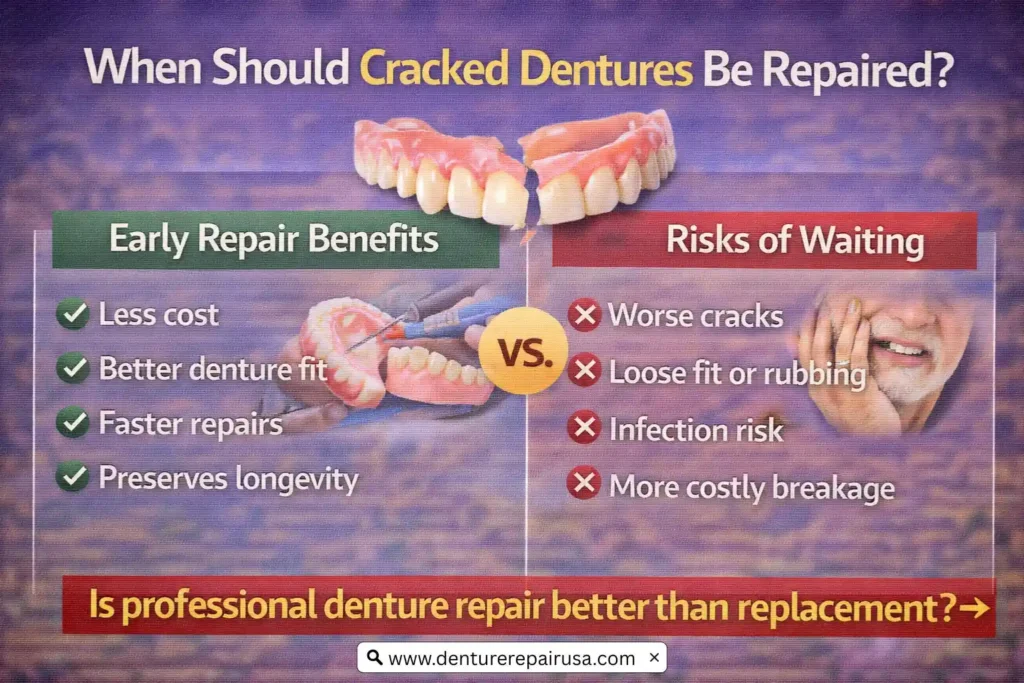
What can happen if you keep wearing a cracked denture?
- A hairline crack becomes a full break. Chewing pressure focuses on the crack, so it tends to creep longer until the denture splits, sometimes mid-meal. One crack is usually easier to fix than a denture in several pieces, especially if a piece gets lost.
- Sharp edges cut your mouth. Crack edges can be sharp. If the crack opens slightly when you bite, it can pinch your gum, cheek or tongue.
- Sore spots. A cracked base no longer spreads biting pressure evenly. The area near the crack can press or rub, and sores under a denture heal slowly if you keep wearing it.
- Trapped bacteria and odor. Your brush can’t reach inside a crack, so food, plaque and yeast build up there. That can cause a bad taste or smell and red, irritated gums.
- An uneven bite. If one side of the crack shifts even a little, your teeth may not meet evenly. You may start favoring one side, which can leave your jaw tired or sore.
- Pieces coming loose. A denture tooth or small piece of plastic can break free while you eat or sleep, and could be swallowed, or even breathed in, by accident.
How can you tell a hairline crack from a structural crack?
A hairline (surface) crack is a fine line that stays in the surface. A structural crack goes deeper or all the way through the base, so the denture can bend or split along it. You can often tell at home. Go gently:
- Work over a folded towel or a sink partly filled with water, in case it slips.
- Rinse it in lukewarm water and pat it dry; lines show up better when dry.
- Look under a bright light. A magnifying glass or your phone camera’s zoom helps.
- Check both sides. If the same line shows on the gum side and the outer side, it likely goes all the way through.
- Glide a fingernail lightly across the line. If it slides over, it is more likely a surface line. If it catches, the crack is deeper.
- Look for a step or gap. If one side sits higher, or you can see a space, the crack is structural.
- Take a clear photo so you can tell later whether the crack is growing.
Do not bend, twist or squeeze the denture to “test” the crack, bite down hard on it, or poke it with a pin. That kind of force is exactly what turns a hairline crack into a break.
Cracks that start at an edge, between the front teeth, or down the middle of an upper denture’s roof are more likely to spread.
| What you notice | Hairline (surface) crack | Structural crack |
|---|---|---|
| Where you see it | On one surface only, smooth and level | On both sides, or with a gap, step or sharp edge |
| Fingernail check | Nail slides over it | Nail catches in it |
| While wearing it | Feels the same, no pain | Pinching, clicking, flexing or pain |
| What to do | Soft foods, out at night, repair within a day or two | Stop wearing it and get it repaired now |
Home checks are only a guide. If you are not sure, treat it as structural and leave the denture out until it is repaired.
What should you do today if your denture is cracked?
- Stop chewing hard foods. Skip nuts, crusty bread, raw apples, tough meat, ice and sticky candy. Choose soft foods cut small, chew slowly on both sides, and don’t bite with your front teeth.
- Take it out at night. Some people clench or grind in their sleep without knowing it, and that pressure goes straight into the crack.
- Clean it gently. Use a soft denture brush, lukewarm water and mild soap or denture cleaner, over a towel or basin of water. Avoid hot water (it can warp the base), regular toothpaste (too rough) and bleach, and don’t scrub into the crack.
- Store it safely. Keep it in a covered case, in water or denture soaking solution so it doesn’t dry out, where it can’t be knocked off a counter or reached by pets.
- Keep every piece. Save any chip or tooth that came off, even tiny ones, in a small sealed bag inside the case. Don’t press pieces back into place.
- Don’t glue it. Glue is not made for your mouth. It can set the pieces slightly out of line and leave residue that must be removed before a proper repair. Here’s more on why super glue is not a safe denture fix. The same goes for home repair kits and filing sharp edges yourself.
- Plan the repair within a day or two, before the crack can grow.
When is a cracked denture an emergency?
Most cracks are urgent, but not a medical emergency. Here’s how to tell.
Get medical help right away if:
- You may have swallowed or breathed in a piece and are coughing, choking, wheezing, or having trouble breathing or swallowing. Call 911.
- A cut in your mouth is deep or won’t stop bleeding with firm pressure.
If you think you swallowed a small piece but feel fine, call your doctor for advice.
See your dentist soon if:
- A sore, cut or red patch in your mouth isn’t healing.
- Your gums are swollen or bleeding, or you notice pus or a bad taste that won’t go away.
- You have pain, or the denture felt loose or rocked before it cracked.
We repair dentures but don’t examine mouths or treat sores, so your dentist is the right person here.
Get it repaired the same day if:
The denture is in pieces, the crack goes all the way through or has a sharp edge, a tooth is loose or missing, a clasp on a partial is broken, or you can’t eat or speak comfortably without it.
In the St. Louis area, see emergency denture repair in St. Louis for fast help.
How quickly can a cracked denture be repaired?
Often the same day. At Total Denture Repair, most repairs are finished the same day, and many take just a few hours. We use ADA-approved materials, and every repair has a 30-day warranty.
- Walk in: If you’re looking for denture repair near you in St. Louis, walk-ins are welcome at 9495 Page Ave, St. Louis, MO 63132, Monday to Friday, 10 AM to 6 PM. We’re closed weekends, so if it cracks on a Saturday, follow the steps above and come in Monday.
- Mail in: Not close by? With mail-in denture repair, you order online and we send a free USPS shipping label. We repair it the same day we receive it and return it free by USPS Priority Mail (USPS Express return is $30 more). Pack every piece.
Crack and fracture repairs start at $150 for one crack, $179 for two and $269 for three. If a denture tooth came off and you still have it, tooth repairs start at $120. A new replacement tooth or a clasp repair gets a free quote. Some customers pay with HSA or FSA funds; check with your provider.
Read more about our same-day denture repair, or call (314) 733-5372 if you’re not sure your crack can wait.
Frequently asked questions
Can I keep using denture adhesive on a cracked denture?
Adhesive won’t hold a crack together, so don’t use it to try. It can squeeze into the crack, where it is hard to clean out, and make a cracked denture feel steadier than it is. If you normally use a little, don’t add extra to stop rocking.
Is a cracked partial denture any different?
The same advice applies to the pink plastic base of a partial. Partials also have metal clasps that hook around your natural teeth. A bent or broken clasp can poke your gums or cheek and let the partial rock, straining the crack. Don’t bend a clasp back yourself; we repair partial bases, clasps and teeth.
Will I be without my denture during a mail-in repair?
Yes, for the days it spends in the mail. The repair is done the day it arrives, so most of the wait is shipping. If you have an older spare denture that still fits comfortably, you can wear it meanwhile.